Spotlight on Female Musicians: Marie-Claire Alain
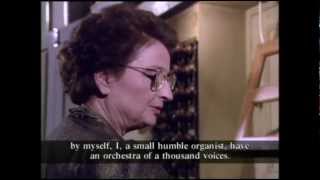
Yesterday was International Womens' Day, and through the weekend we will be sharing the stories of female musicians whom we find to be particularly inspiring. Today we look at Marie-Claire Alain (1926-2013), a French organist and teacher. She came from a notable family of musicians; her older brother was an organist and composer named Jehan Alain. During WWII, he left his job as an organist to join the French Resistance as a dispatch rider. While investigating the German advance, he encountered a troop of Nazi soldiers and killed fifteen of them before being killed himself (he was posthumously honored by both the French and Germans for his bravery). Marie-Claire was only fourteen when her brother died. She studied under great composers such as Ravel and Duruflé, and excelled in school, winning four first prizes at the Conservatoire de Paris. An internationally ranking organist, her list of students eventually became a "who's who of the present-day organ world". She was the most-recorded organist in the world. To give an idea of the scale of her output, let's explore what that meant. Marie-Claire Alain created over two hundred and sixty recordings. Bach composed over two hundred and fifty works for organ, many of which were multi-movement pieces. Marie-Claire Alain not only recorded the entirety of Bach's organ works, she did so THREE TIMES. She worked on this undertaking from the 1960s to the 1990s, playing organs all over the world; the third cycle was performed on organs from Bach's time, several of which he personally played centuries before. She also recorded the entire organ works of over a dozen other composers, and was a special advocate of the music of her late brother Jehan. She not only was a brilliant performer, she was an incredible scholar who did immense research into the history of the music she performed. "...I have researched Bach himself, his life, his work. I think I have been able to get closer to the real meaning of the music...I have done a good deal of work on the theological aspects of Bach’s music, which is very important. It reveals an enormous amount of meaning. You can’t play a Bach chorale, for example, without knowing the liturgical text on which it is based, without knowing why it was written.”
Her dedication to revealing the intentions of the composers whose music she performed, and her massive flock of students cause her to be arguably the most influential female organist (and one of the most influential organists, period) of all time.



Comments